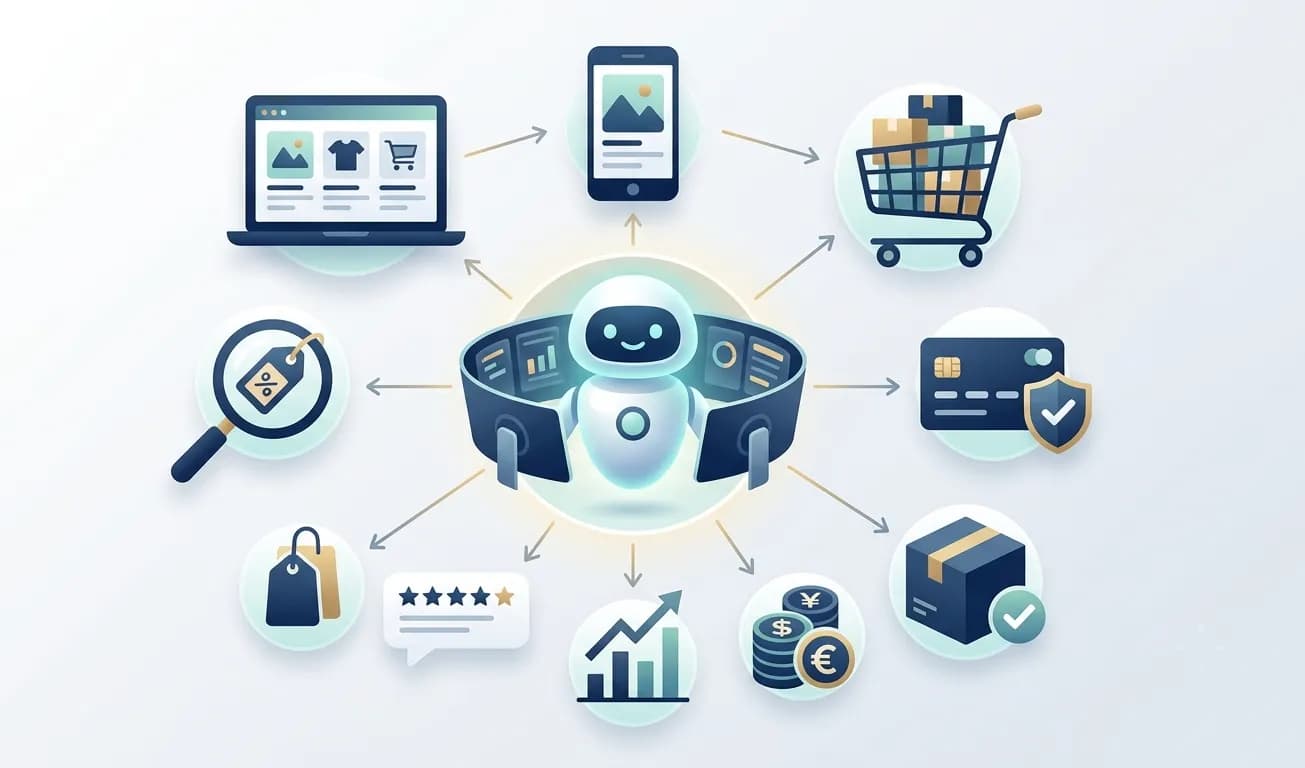
During Cyber Week 2025 alone, AI agents influenced $67 billion in global sales — touching one in every five orders placed worldwide. That's not a projection. That already happened. And it's just the opening chapter of a much bigger shift: AI agents that don't just recommend products, but actually discover, compare, and complete purchases on a shopper's behalf.
This is agentic commerce, and it's moving from experiment to infrastructure faster than most businesses have registered. If your growth strategy still assumes every customer is a human clicking through your website, it's time to update the model.
What Is Agentic Commerce, Exactly?
Agentic commerce is shopping where an AI agent — not a human — handles part or all of the buying journey. Instead of a person searching Google, comparing tabs, and clicking "buy," an AI assistant does the discovery, comparison, and sometimes the checkout itself, often without the shopper ever visiting a website directly.
This isn't the same as a chatbot suggesting a product. It's AI agents actually completing transactions — and major infrastructure is already built specifically to support it: Stripe and OpenAI launched the Agentic Commerce Protocol in late 2025, Google introduced its own Universal Commerce Protocol in early 2026, and Shopify's merchant base is already reachable for AI-agent checkout through these systems.
The Numbers Behind the Shift
The scale here is hard to overstate:
- AI-referred retail traffic grew 393% year-over-year in Q1 2026, and converts about 42% better than traditional search referrals.
- ChatGPT alone handles roughly 50 million shopping queries a day.
- 73% of consumers are already using AI somewhere in their shopping journey — for product ideas, comparing prices, or summarizing reviews.
- 70% of shoppers say they're at least somewhat comfortable with an AI agent making purchases on their behalf.
- McKinsey projects agentic commerce could reach $3 to $5 trillion globally by 2030.
- Gen Z and Millennials are adopting AI shopping tools at 2x the rate of Gen X, and 11x the rate of Boomers — though older generations are catching up fast, with Boomer adoption up 92% over the past two years.
This is not a niche behavior confined to early adopters. It's spreading across every age group, and doing so quickly.
Where the Real Challenge Lies: The Trust Gap
Here's the part most businesses miss: consumer comfort with AI shopping doesn't move in a straight line. People trust AI for research far more than they trust it to actually spend their money.
- 65% of consumers trust AI to compare prices — but only 14% trust it to place an order autonomously.
- Only about 13% of consumers have completed a purchase after being referred by an AI assistant, despite the vast majority already using AI somewhere in the process.
- 83% of consumers express real privacy and data concerns about AI-driven shopping.
In other words: adoption of AI for research is way ahead of trust in AI for transactions. That gap is exactly where the next few years of agentic commerce will be decided — and it's a signal, not a wall. The businesses that build transparency and control into the buying experience now will be the ones consumers trust first when that gap closes.
What This Means for Your Business
- Product discovery is shifting away from your website. If an AI agent is doing the browsing and comparing, your product needs to be structured, accurate, and easy for that agent to understand — not just easy for a human to read.
- Traditional analytics are going dark. In agent-mediated shopping, the browsing and consideration phase often happens entirely inside the AI platform — meaning your usual funnel data (impressions, clicks, dwell time) simply won't capture it.
- AI-generated product recommendations convert significantly better than traditional search — a real opportunity for businesses that get their product data agent-ready early.
- Fraud and authentication are becoming real operational concerns. A large share of financial institutions expect fraud to increase specifically because of AI shopping agents, and new authentication standards (like "Know Your Agent" protocols) are emerging to address it.
- B2B isn't exempt. Gartner expects the majority of B2B purchases to run through AI agents by 2028, routing trillions of dollars through machine-to-machine transactions.
Worth Noting: In traditional e-commerce, retailers can see the entire customer journey — every click, every hesitation, every abandoned cart. In agent-mediated commerce, that visibility often starts only at the add-to-cart moment. Businesses that don't adapt their data and discovery strategy risk becoming invisible during the part of the journey that matters most.
How Businesses Can Prepare
- Make your product data agent-readable. Structured, accurate, up-to-date product information helps AI agents represent your business correctly — and choose it in the first place.
- Invest in API-first, interoperable systems. Businesses built on flexible, connected infrastructure are better positioned to participate as agent-driven demand grows.
- Don't abandon the human-facing experience. Trust in autonomous purchasing is still low — a smooth, transparent website experience still matters for the large share of shoppers not ready to hand over full control.
- Watch for new authentication and fraud standards. As agent traffic grows, expect stricter systems for verifying legitimate AI agents versus malicious bots — plan your fraud detection accordingly.
- Treat this as a strategic shift, not a marketing trend. The businesses winning early aren't chasing hype — they're quietly building the data and infrastructure foundations that agentic commerce actually runs on.
The Bottom Line
Agentic commerce isn't a future trend to prepare for someday — it's already influencing billions of dollars in sales today. The gap between AI-assisted research and AI-completed purchases is closing, and the businesses ready for it — with clean data, flexible infrastructure, and a trustworthy buying experience — will be the ones AI agents actually choose to recommend.
At Elite Web Technologies, we help businesses build the digital foundations — structured data, flexible architecture, and e-commerce systems — ready for where commerce is actually heading.
Want to make sure your business is ready for agent-driven shopping?Contact Elite Web Technologies to talk through your strategy.