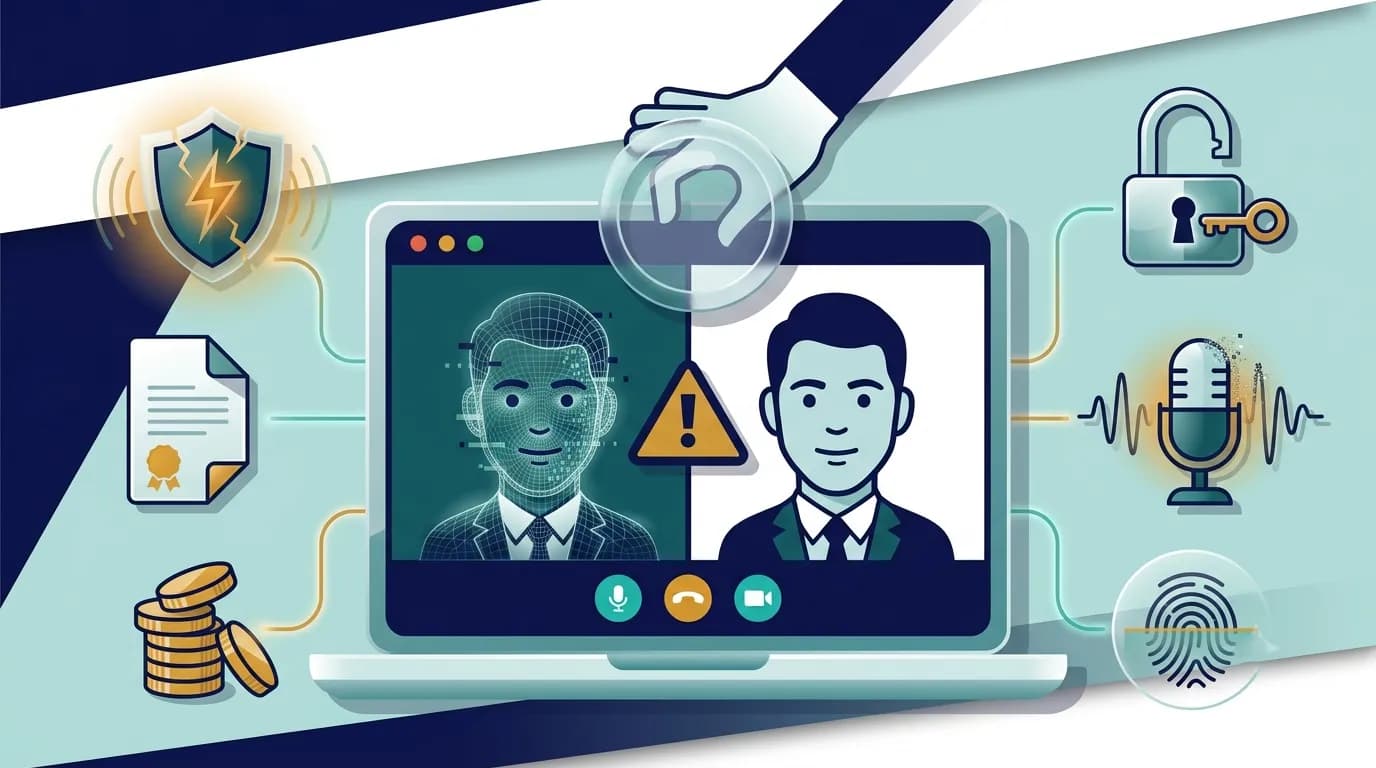
In January 2024, an employee at engineering firm Arup joined what looked like a routine video call with company executives. Every face on the call was real-looking, every voice sounded right. None of it was real. The company wired $25.6 million before anyone realized they'd been talking to deepfakes the entire time.
That case is no longer a rare horror story — it's a preview. In 2026, 62% of organizations report experiencing at least one deepfake-enabled attack in the past year. And the numbers behind that stat should worry any business that still trains employees with an annual slideshow and calls it cybersecurity.
The Scale of the Problem, in Real Numbers
- AI-generated phishing emails now succeed 54% of the time against human targets — roughly 4.5 times higher than the 12% success rate of traditional, human-written phishing.
- Deepfake fraud attempts grew by 1,300% year-over-year, jumping from roughly one incident per month to seven per day.
- 41% of organizations have experienced a deepfake combined with social engineering on an audio call, and 35% on a video call — the exact pattern behind the Arup incident.
- Synthetic voice attacks rose 475% at insurance companies and 149% at banks in a single year.
- A voice can now be cloned from just a few seconds of publicly available audio — a conference talk, a podcast appearance, even a voicemail greeting.
- Humans detect deepfakes at only around 55.5% accuracy — barely better than a coin flip.
Put simply: the attacker's tools have gotten dramatically better, faster, and cheaper, while human ability to spot the fake hasn't meaningfully improved at all.
Why This Is an "AI vs. AI" Problem
The old cybersecurity playbook assumed a human attacker on the other end — someone who made typos, used a slightly-off email address, or couldn't quite fake a voice. That assumption no longer holds.
- The cost of the attack has collapsed. Freely available open-source tools and low-cost dark web services now let attackers generate convincing deepfakes without any real skill in exchange.
- Attacks assemble in hours, not weeks. A criminal can research a target online, clone a voice from a public recording, generate a deepfake video, and launch a multi-channel attack in a single afternoon.
- Detection tools are struggling to keep pace. Deepfake detection remains probabilistic, not definitive — and the generation tools improve faster than the detection tools built to catch them.
- The attacks are getting more concentrated, not just more frequent. Overall fraud rates have actually declined in some regions even as deepfake-driven attacks grow more damaging — fewer, more targeted, higher-stakes attacks are replacing high-volume, low-effort scams.
This is exactly what "AI vs. AI" means in practice: the fight is no longer businesses versus a human con artist. It's increasingly a contest between AI-generated attacks and AI-assisted defenses, with human judgment caught in the middle and struggling to keep up.
Why Most Businesses Aren't Ready
- Training hasn't caught up. Most organizational defenses still rely on annual training cycles and static verification protocols designed before synthetic media became this convincing.
- Governance often stops at the technical team. Deepfake risk is increasingly a board-level accountability issue — in high-resilience organizations, 30% of board members hold personal liability for cyber breaches, compared to just 9% in low-resilience ones. Many businesses haven't made that connection yet.
- Identity verification is quietly becoming unreliable. A meaningful share of enterprises are expected to no longer trust face-biometric identity verification on its own, precisely because deepfakes have gotten good enough to fool it.
- Most companies still lack a formal response plan. A large share of organizations have no documented plan for what to do when a deepfake incident actually happens — leaving the response improvised in the exact moment it needs to be fastest.
Worth Noting: Regulatory pressure is catching up. The EU's Article 50 enforcement begins in August 2026, and the FBI has created its first standalone AI-fraud category for reporting — a signal that deepfake-enabled fraud is now being treated as its own distinct threat category, not a subset of ordinary phishing.
How Businesses Can Actually Defend Against This
- Replace annual training with continuous, multi-channel simulations. Practice against real attack vectors — email, voice, SMS, and video — not just a once-a-year slideshow nobody remembers by March.
- Build out-of-band verification into financial processes. Any wire transfer, credential reset, or high-stakes request triggered by a call or video should be confirmed through a separate, pre-agreed channel — exactly the step that could have stopped the Arup case.
- Don't rely on face or voice biometrics alone. Layer additional authentication methods rather than trusting a single identity signal that deepfakes are specifically designed to fool.
- Establish a documented incident response plan before you need one. Decide now who verifies suspicious requests, how, and how fast — improvising this during an active attack is how mistakes happen.
- Bring deepfake risk to the board, not just IT. Given the direct link between board engagement and organizational resilience, this needs to be a governance conversation, not a purely technical one.
- Pair technology with process. Detection tools help, but the businesses actually reducing risk combine media inspection with human verification steps that don't depend on trusting what someone sees or hears alone.
The Bottom Line
Deepfake phishing isn't a future risk to prepare for eventually — it's already cost real companies tens of millions of dollars, and the tools behind it are only getting cheaper and more convincing. The businesses staying ahead of this aren't the ones hoping employees will spot a fake. They're the ones building verification processes that don't depend on trusting a face or a voice at all.
At Elite Web Technologies, our AI Automation & Workflow practice is built under our ISO/IEC 42001:2023-certified AI governance framework, helping businesses put the right safeguards and verification processes in place from the start — not bolted on after an incident.
Want to know if your business's verification processes could withstand an AI-powered impersonation attempt?Contact Elite Web Technologies for a security review.