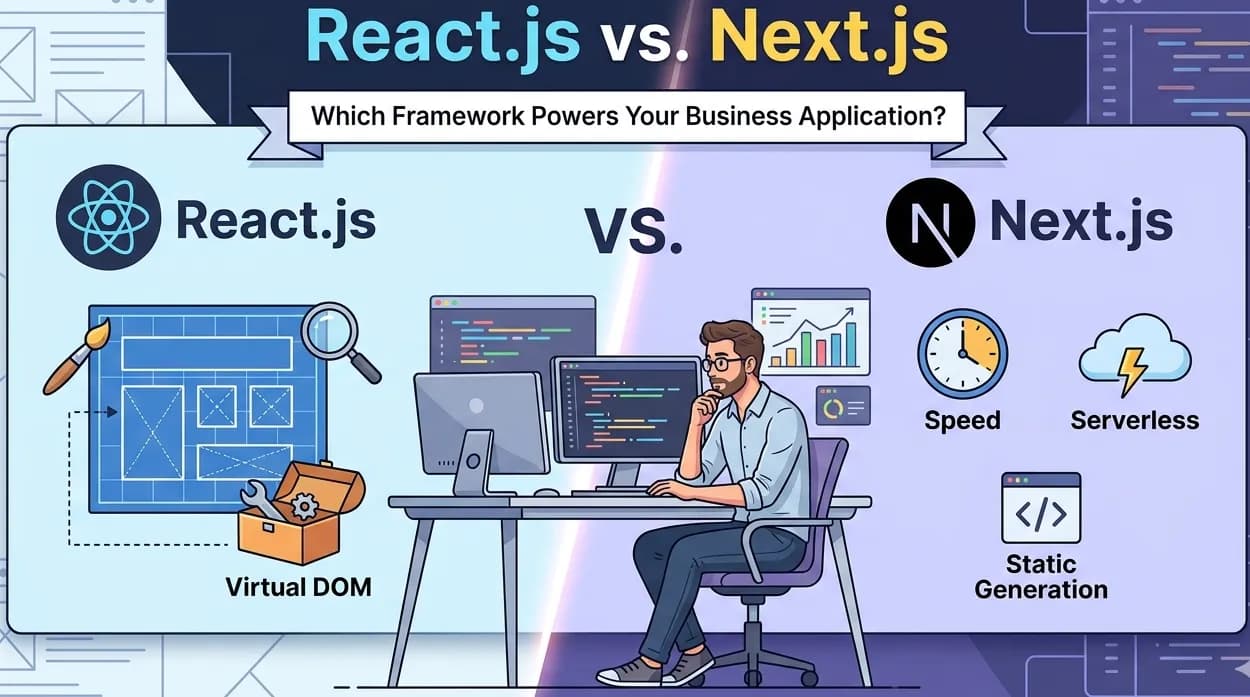
In today's competitive digital landscape, the foundation of your web application can significantly impact its performance, scalability, and ultimately, your business success. When evaluating modern web technologies, two names frequently emerge in the JavaScript ecosystem: React.js and Next.js. While often discussed in the same breath, they serve distinct purposes and offer different advantages.
For founders, product managers, and technical leads, understanding the core differences between these powerful tools is crucial for making an informed decision that aligns with your strategic objectives and technical requirements. This guide will clarify the distinctions, highlight their strengths, and help you determine whether React.js or Next.js is the optimal choice for your next web application.
Understanding the Fundamentals: Library vs. Framework
Before diving into a direct comparison, it's essential to understand what each technology truly is:
React.js: The UI Library at its Core
At its heart, React.js is a JavaScript library for building user interfaces. Developed and maintained by Facebook (now Meta), it excels at creating interactive, component-based UIs. React's primary focus is on the "view" layer of an application, meaning it handles what users see and interact with. Its core philosophy revolves around declarative programming, making it easier to reason about your UI as data changes.
- UI Library: React is specifically designed for building user interfaces, not a complete application framework.
- Client-Side Rendering (CSR): By default, React applications render their content directly in the user's browser after the initial page load. This means the browser downloads a minimal HTML file and then JavaScript takes over to build the UI.
- Flexibility for Custom Setups: React provides immense flexibility. Developers can choose their preferred routing libraries (e.g., React Router), state management solutions (e.g., Redux, Zustand), and build tools (e.g., Webpack, Vite). This freedom allows for highly customized architectures.
React is ideal when you need a robust, component-driven UI for a Single-Page Application (SPA) or when integrating interactive elements into an existing non-React application.
Next.js: The Full-Stack React Framework
Next.js is a powerful, open-source React framework developed by Vercel. Crucially, it's built *on top of* React, extending its capabilities significantly. Next.js provides a structured, opinionated approach to building full-stack React applications, offering out-of-the-box solutions for common web development challenges.
- React Framework: Next.js is a complete framework that leverages React for UI, but adds powerful features for routing, data fetching, API routes, and more.
- Offers SSR, SSG, and ISR: Beyond client-side rendering, Next.js provides built-in support for Server-Side Rendering (SSR), Static Site Generation (SSG), and Incremental Static Regeneration (ISR), enhancing performance and SEO.
- Built-in Optimizations: It comes with automatic code splitting, image optimization, font optimization, and other performance enhancements that would typically require manual configuration in a pure React setup.
- API Routes: Next.js allows you to create backend API endpoints directly within your project, simplifying full-stack development.
Next.js is designed for applications that require enhanced performance, better SEO, and a streamlined development experience for both frontend and backend logic.
Key Differentiators: What Next.js Adds to React
The primary distinctions between React.js and Next.js lie in the functionalities Next.js provides out-of-the-box, addressing common enterprise-level requirements.
Rendering Strategies: Performance and SEO Advantages
This is perhaps the most significant difference. While React.js primarily uses Client-Side Rendering (CSR), Next.js offers a spectrum of rendering options:
- Client-Side Rendering (CSR - React's Default): The browser downloads a minimal HTML file and then executes JavaScript to render the full content. Great for highly interactive SPAs, but can lead to slower initial load times and challenges for search engine crawlers that don't fully execute JavaScript.
- Server-Side Rendering (SSR - Next.js): The server renders the initial HTML for each request and sends it to the browser. This results in faster perceived load times and improved SEO, as search engine bots receive fully rendered pages.
- Static Site Generation (SSG - Next.js): Pages are rendered into HTML at build time and then served as static files. This offers incredibly fast performance and excellent SEO, as there's no server-side processing per request. Ideal for content-heavy sites like blogs or documentation.
- Incremental Static Regeneration (ISR - Next.js): A hybrid approach that allows you to update static pages after they've been built, without rebuilding the entire site. This is perfect for e-commerce sites or news portals where content updates regularly but doesn't need to be fetched on every request.
For businesses where search engine visibility and initial load speed are critical, Next.js's rendering capabilities offer a substantial advantage.
Routing System
- React.js: Requires external libraries like React Router to manage navigation. Developers must configure routes manually.
- Next.js: Features a file-system-based router. Any file in the
pagesdirectory automatically becomes a route, simplifying setup and organization for scalable web applications.
API Routes and Full-Stack Capabilities
- React.js: Primarily frontend. To build a full-stack application, you'd typically need a separate backend (e.g., Node.js with Express, Python with Django) and manage API calls between them.
- Next.js: Offers built-in API routes, allowing you to create serverless functions (Node.js endpoints) directly within your Next.js project. This streamlines full-stack development expertise, keeping frontend and backend logic co-located.
Performance Optimizations
Next.js includes a suite of performance enhancements out-of-the-box:
- Automatic Code Splitting: Only the JavaScript needed for a particular page is loaded, improving initial load times.
- Image Optimization: The
next/imagecomponent automatically optimizes images for different devices and viewports, reducing file sizes without compromising quality. - Font Optimization: Reduces layout shift and improves text rendering.
- Fast Refresh: A robust hot-reloading experience for development.
These features significantly contribute to a better user experience and higher Lighthouse scores, which are increasingly important for SEO.
When to Choose React.js (Alone)
Despite Next.js's powerful features, there are specific scenarios where opting for pure React.js remains the better choice:
- Simple Single-Page Applications (SPAs): For applications that are primarily client-side interactive, do not require strong SEO, and have minimal content (e.g., internal dashboards, simple tools), React.js provides all the necessary tools without the overhead of a full framework.
- Rapid Prototyping: If your goal is to quickly build and test a UI concept without worrying about server-side concerns or advanced optimizations, React's flexibility allows for very fast iteration.
- Integrating into Existing Non-Next.js Applications: When you need to add a modern, interactive UI component to an existing application built with a different backend technology (e.g., Ruby on Rails, PHP, Java), React.js can be seamlessly integrated into specific parts of the page without requiring a full framework adoption.
- Highly Custom Setups: For development teams that prefer complete control over every aspect of their build process, routing, and data fetching, React's library-first approach offers maximum flexibility to build a truly bespoke architecture.
When to Choose Next.js
Next.js truly shines for projects with specific business requirements that go beyond just UI rendering:
- SEO-Critical Websites: If your business relies heavily on organic search traffic (e.g., e-commerce stores, content platforms, news sites, blogs), Next.js's SSR and SSG capabilities ensure that search engines can easily crawl and index your content.
- E-commerce Platforms: These sites demand fast load times, excellent SEO for product pages, and often require dynamic content updates (ISR). Next.js provides the perfect blend of performance and content freshness.
- Content-Heavy Platforms: For applications with a large volume of articles, documentation, or marketing pages, SSG can deliver unparalleled speed and reliability.
- Full-Stack Applications: When you need to build both the frontend and backend of an application within a single codebase, Next.js's API routes simplify development and deployment.
- Applications Requiring High Performance: For any application where speed and user experience are paramount, Next.js's built-in optimizations and advanced rendering strategies provide a significant advantage.
- Large-Scale and Enterprise Applications: The opinionated structure and comprehensive feature set of Next.js help manage complexity, enforce best practices, and accelerate development for bigger projects with multiple teams.
Empower Your Digital Vision with Elite Web Technologies
Choosing the right technology stack is a critical decision that impacts your application's future. Whether your project demands the flexibility of React.js or the robust, performance-driven capabilities of Next.js, Elite Web Technologies has the expertise to bring your vision to life. We specialize in crafting high-performance, scalable web applications tailored to your specific business needs. If you're navigating these choices or ready to start your next project, we invite you to connect with our team. Let's discuss your objectives and identify the optimal technology solution to drive your digital growth.