Every development company's website looks impressive. Five-star reviews, polished portfolios, confident promises. So how do you tell a great partner from an expensive mistake?
The honest answer is that the best signal isn't the sales pitch. It's how a company answers specific questions, and how comfortable they are being asked. A good partner welcomes hard questions. A nervous one deflects them.
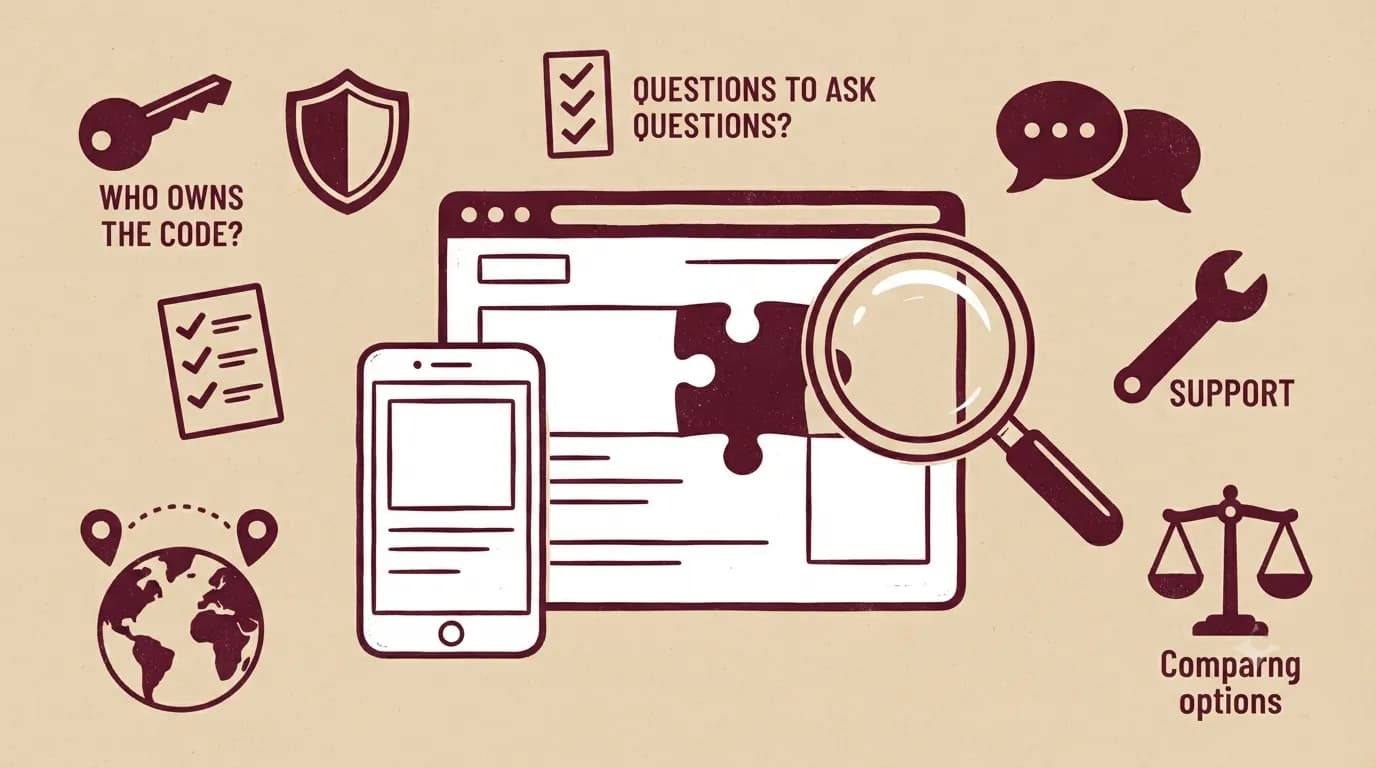
This guide gives you ten questions to ask before you sign anything, what a good answer sounds like, and what should make you pause. It's based on advice that repeats across industry guides, plus practical experience of how web and app projects go right or wrong.
1. Who Exactly Will Work on My Project?
Agencies often send their most senior people to the sales call, and different people do the work.
- A good answer: Names the roles on your project, says whether they're full-time employees or contractors, and offers to let you meet the people doing the work.
- A warning sign: Vague answers like "our team of experts," or a refusal to say who will be involved.
2. Have You Built Something Like This, and Can I Talk to Past Clients?
Relevant experience matters more than a long list of logos.
- A good answer: Shows live, working products you can try, and shares references you can call.
- A warning sign: Only screenshots, no references, or only hand-picked recent clients. Ask for several past clients, then choose which ones to call.
When you speak to a reference, ask what went well, what went badly, and whether they would hire the team again.
3. How Will We Start? Is There a Discovery and Design Phase?
How a project begins tells you a lot about how it will finish. A partner who jumps straight into coding is guessing.
- A good answer: Explains a planning phase that clarifies goals, users, and features, and includes wireframes or a prototype you can approve before development. Our post on why wireframes come before code explains why this saves time and money.
- A warning sign: A fixed price and a start date with no questions about your business.
4. Who Owns the Code, the Designs, and the Accounts, and When?
This is one of the most important questions, and it should have a clear, immediate answer.
- A good answer: You own the code, designs, and data. Your domain, hosting, and code repositories sit in accounts you control, and ownership is written in the contract.
- A warning sign: Ownership that transfers only on final payment, code held in the vendor's own accounts, or hidden licensing terms.
5. How Will We Communicate, and When Are You Available?
Poor communication is one of the most common reasons outsourced projects go wrong.
- A good answer: A named contact, a regular schedule of updates, a demo of working software every week or two, and a stated response time for questions.
- A warning sign: "We're agile" and "we'll keep in touch," with nothing specific.
If your team is in a different time zone, ask about overlap with the people doing the work, not just the account manager. Several industry guides suggest that three to four shared hours a day is workable for most projects.
6. How Do You Handle Changes to the Scope?
Changes will happen. What matters is whether they're managed or silent.
- A good answer: Each change is written down, with its effect on cost and time stated before work begins. You approve it, delay it, or drop it.
- A warning sign: "Don't worry, we'll sort it out," or surprise invoices.
7. What Does Your Quote Include, and What Doesn't It?
A low price means little if it leaves out half the project.
- A good answer: A clear breakdown, a list of assumptions and exclusions, and payments tied to milestones you can see.
- A warning sign: One lump sum, a demand for full payment upfront, or a price far below every other proposal with no explanation.
Also ask about ongoing costs that sit outside the quote, such as hosting, paid third-party services, and licences.
8. How Do You Test Your Work and Protect Our Data?
Testing and security are easy to skip in a sales conversation, and expensive to fix later.
- A good answer: A clear testing process across devices and browsers, controlled access to your code and credentials, and secure handling of customer data. If you work in a regulated area such as healthcare or finance, they should talk comfortably about those requirements.
- A warning sign: "We test everything" with no detail, or no mention of who can access your systems.
9. What Happens After Launch?
Software needs looking after. Launch is the start, not the end.
- A good answer: A defined period for fixing early bugs, options for ongoing support and updates, and documentation so that someone else could take over if needed.
- A warning sign: No mention of support, or a handover that's just "here's the files."
10. How Do You Use AI in Your Work, and How Do You Protect Our Code and Data?
This is a newer question, and a good one. Many development teams now use AI coding tools, and it's reasonable to ask how.
- A good answer: Explains where AI tools are used, confirms that people review the output, and says how your code, data, and confidential information are kept out of public tools. If your product includes AI features, they should talk about testing, oversight, and clear limits on what the AI can do.
- A warning sign: "We don't use it" with no explanation, or "we use it everywhere" with no mention of review or data protection.
Worth Noting: No checklist replaces talking to real past clients. Use these questions to find out how a company thinks, and use references to find out how they behave.
A Few Extra Checks for Distributed Teams
Many excellent projects are delivered by teams in a different country from the client. Location matters less than structure. If you're working across time zones, also check:
- Overlapping working hours, in writing
- Which holidays the team observes
- How payments, currency, and invoices work
- Which country's law applies to the contract
- Who your escalation contact is if something goes wrong
Red Flags at a Glance
- Refuses to share references
- Vague about who will do the work
- Unclear ownership of code and accounts
- No planning or design phase
- Pushes you to sign quickly
- Doesn't ask you anything about your business
How to Use This List
- Shortlist three companies
- Ask all ten questions, and get the answers in writing
- Call at least two references for each
- Compare answers, not just prices
- Notice how each company reacts to being asked
The Bottom Line
Choosing a development partner is one of the most important decisions in any digital project. Price matters, but clarity matters more: who does the work, who owns the result, how you'll communicate, and what happens when plans change.
Elite Web Technologies has been building for clients since 2007, with offices in Panchkula, India and Hicksville, New York. Our work is backed by ISO/IEC 42001:2023 certification for AI management, and we're listed on Google (4.9/5), Clutch (5.0), and GoodFirms (5.0), and as a Top Rated agency on Upwork. We're happy to answer all ten of these questions before you sign anything. You can read our FAQs, browse our portfolio, or explore our services in React.js / Next.js, Flutter, iOS, Android, Marketplace Development, and Wireframing & Prototyping.
Comparing development partners and want straight answers?Contact Elite Web Technologies and bring your questions.