72% of SaaS startups name architecture as their single biggest driver of technical debt. Not marketing. Not funding. Not even the product itself — the underlying architecture decisions made in the first few months, usually before anyone was thinking about what happens at 10,000 customers instead of ten.
That gap shows up hardest in multi-tenant marketplaces — platforms where multiple independent sellers, vendors, or businesses all operate on shared infrastructure. Get the architecture right early, and adding your 1,000th tenant costs a fraction of adding your 10th. Get it wrong, and every new tenant becomes a little more expensive, a little riskier, and a little harder to support than the last.
What Multi-Tenancy Actually Means
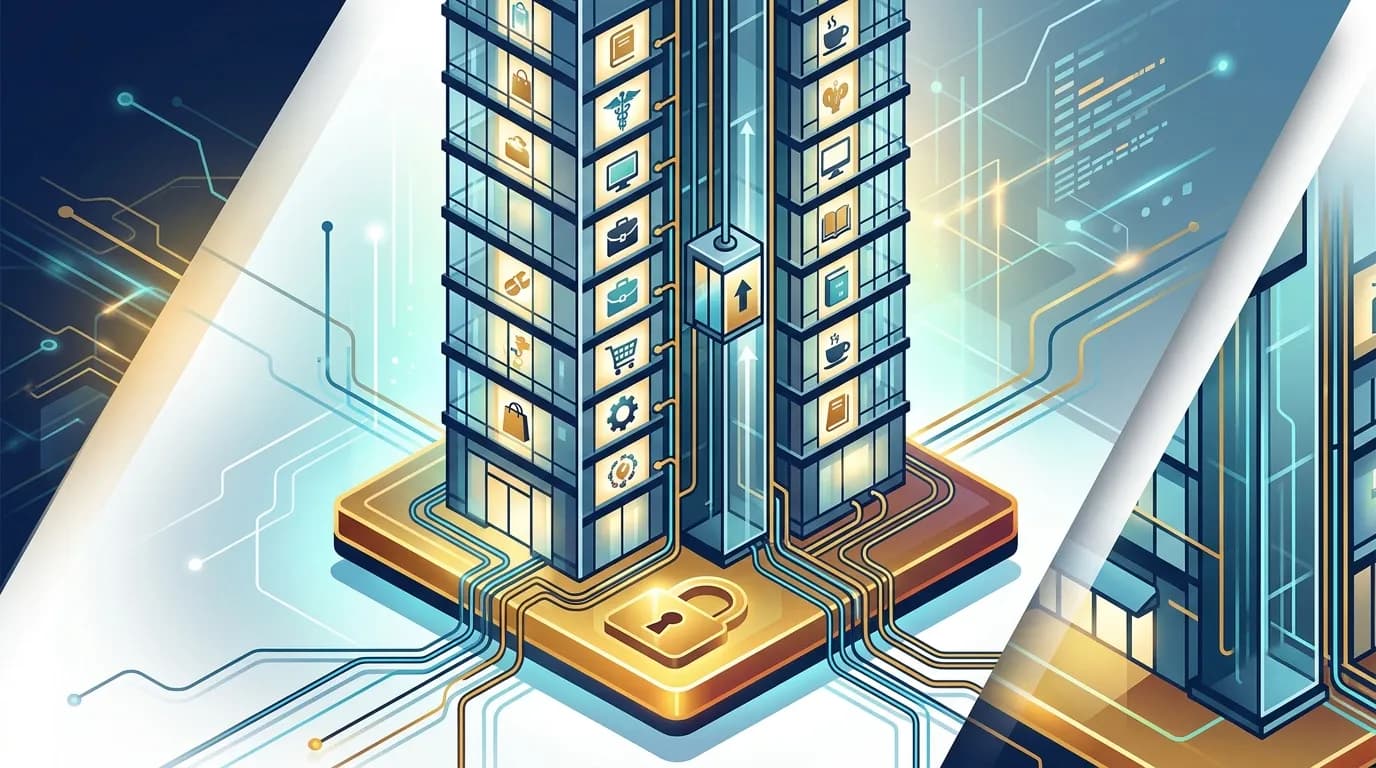
Multi-tenant architecture is a model where a single application instance serves multiple independent customers — tenants — from one shared codebase, with each tenant's data logically separated rather than physically isolated on its own server. In a marketplace context, that might mean dozens or thousands of independent sellers, vendors, or storefronts all operating on the same underlying platform, each with their own data, branding, and configuration, without ever seeing each other's information.
This is different from single-tenant architecture, where each customer gets a fully separate, dedicated instance. Single-tenancy offers stronger physical isolation, but scales linearly — every new customer adds infrastructure cost and maintenance overhead. Multi-tenancy keeps the base cost nearly flat as you add tenants, which is exactly why over 70% of modern SaaS vendors now use some form of it.
Decision One: How You Isolate Tenant Data
This is the single most consequential decision in the entire architecture, and it typically comes down to three models:
- Shared database, shared schema — every tenant's data lives in the same tables, distinguished by a tenant ID on each record. This is the most cost-efficient and easiest to scale, but requires strict, consistently enforced tenant-aware queries to prevent one tenant from ever accidentally seeing another's data.
- Shared database, separate schema — each tenant gets its own schema within a shared database instance. This offers stronger separation and more room for tenant-specific customization, at the cost of more operational complexity.
- Separate database per tenant — the strongest isolation, but the least scalable option, since it starts to reintroduce the same linear cost and maintenance problems multi-tenancy is meant to avoid.
For most marketplace platforms, the shared-schema model with a tenant ID enforced at the database level — not just in application code — has become the standard default. Modern guidance is explicit on this: tenant identification should be enforced by middleware and row-level security policies at the database layer, not left to manual filters scattered across application code, since that's exactly where accidental data leaks happen.
Decision Two: Where Isolation Is Actually Enforced
A common mistake is assuming tenant isolation is primarily an application-layer concern. It isn't — and the cost of getting this wrong is real. The average data breach now costs $4.45 million, and in a shared-infrastructure marketplace, a single isolation failure can expose multiple tenants at once, not just one customer.
- Enforce tenant identification through middleware, so every request is scoped correctly before it ever reaches business logic — not as an afterthought inside individual functions.
- Use row-level security at the database layer as a hard backstop, so even a mistake in application code can't leak data across tenants.
- Encrypt tenant data at rest and in transit, and maintain audit logging so every access is traceable after the fact.
- Design with tenant_id on every table from day one. Retrofitting this after a platform has scaled is dramatically more expensive than building it in from the start.
Decision Three: Designing for Horizontal Scale, Not Just More Servers
Scaling a multi-tenant marketplace isn't about adding bigger servers as tenant count grows — it's about designing the system to add more servers cleanly.
- Keep application servers stateless, so new instances can be added or removed without complicated coordination as demand grows.
- Add read replicas before reaching for exotic architecture patterns. A single PostgreSQL read replica can handle roughly 10x the read traffic with minimal code changes — often solving a scaling bottleneck long before anything more complex is needed.
- Use sharding, indexing, and resource quotas to keep performance consistent as tenant count grows, rather than letting a handful of high-traffic tenants degrade the experience for everyone else.
- Choose your database engine deliberately. PostgreSQL has become the default recommendation for the large majority of modern SaaS and marketplace platforms, since it supports relational integrity, flexible JSON storage, and row-level multi-tenancy security within a single engine.
Decision Four: Don't Clone the Same App for Every Tenant
This is a trap many growing marketplaces fall into without realizing it: as new tenant types or requirements come in, teams start forking the codebase — a slightly customized version here, a one-off feature branch there. It feels faster in the moment and quietly recreates the exact cost and maintenance problem multi-tenancy was supposed to solve in the first place.
- Build tenant-specific customization into configuration, not code forks. Branding, feature flags, and business rules should be data-driven settings per tenant, not separate application copies.
- Ship updates once, to everyone. One of the biggest advantages of proper multi-tenancy is deploying a new feature or patch a single time across the entire platform — losing that through forked codebases erases the benefit entirely.
- Onboard new tenants in minutes, not weeks. A well-architected multi-tenant marketplace should be able to provision a new seller or vendor as a new logical tenant almost instantly, not as a new deployment project.
Worth Noting: The average enterprise now manages 305 different SaaS applications. Running a separate, fully isolated instance for every tenant at that scale simply isn't financially realistic for any serious marketplace platform — which is exactly why multi-tenancy has become the default architectural choice rather than the exception.
What This Means for Your Business
- Architecture decisions made in month one determine your cost curve for years. A marketplace platform that scales cleanly from 10 to 10,000 tenants was built that way from the start — it wasn't discovered along the way.
- Isolation failures are a business risk, not just a technical one. In a shared-infrastructure marketplace, a data leak affects your relationship with every tenant on the platform, not just one account.
- The cheapest architecture upfront isn't always the cheapest architecture at scale. Cutting corners on tenant isolation or database design early often costs significantly more to fix later than to build correctly from day one.
- AI-readiness is now part of the architecture conversation too. Nearly 80% of organizations are expected to deploy AI-enabled applications, meaning modern marketplace architecture increasingly needs to support AI workloads (recommendations, fraud detection, matching algorithms) without compromising tenant isolation or performance.
The Bottom Line
Multi-tenant marketplace architecture isn't a background technical detail — it's the decision that determines whether your platform can actually scale, or whether every new tenant makes things a little slower, a little more expensive, and a little riskier than the last. The businesses building marketplaces that scale cleanly are the ones treating tenant isolation, database design, and horizontal scalability as day-one decisions, not problems to solve after growth arrives.
At Elite Web Technologies, our Custom Website Development team has built multi-tenant platforms from the ground up — including hyperlocal marketplace architectures designed specifically for scale, security, and clean tenant isolation. You can see examples of our platform work in our portfolio.
Planning a marketplace platform and want the architecture built right from day one?Contact Elite Web Technologies to talk through your project.