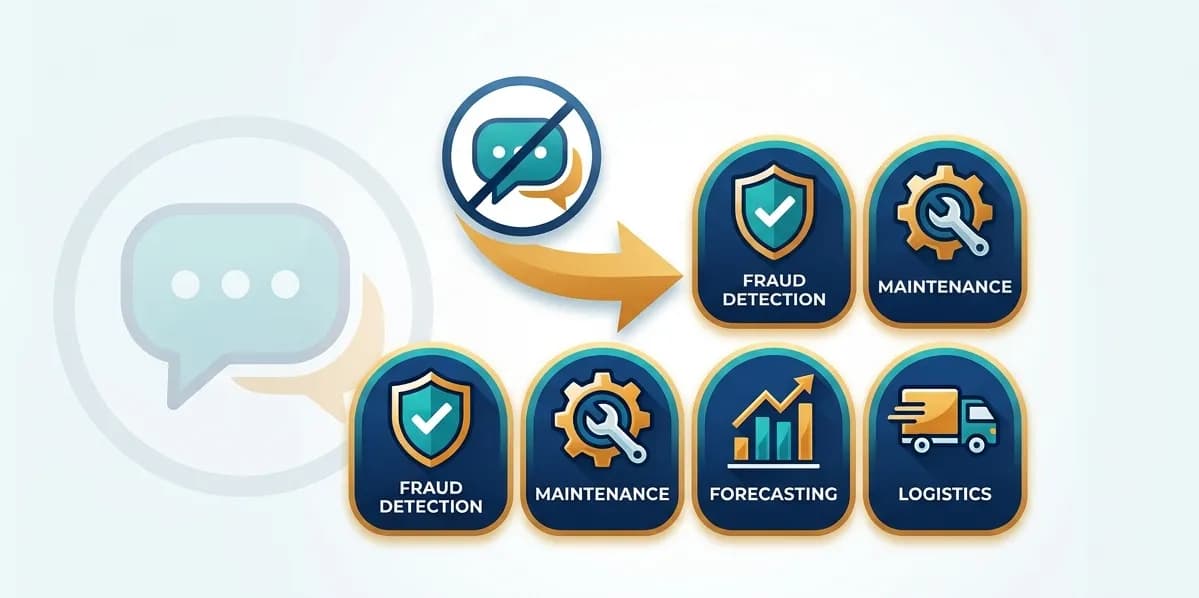
Ask most people what "AI in business" looks like, and they'll picture a chatbot. Understandable — it's the most visible, most talked-about application. But a recent review of dozens of real-world AI deployments across the last few weeks turned up something telling: the biggest wins weren't chatbots at all. They were things like predictive maintenance systems, automated logistics, fraud detection, and repair copilots — the unglamorous, operational work that never makes a headline but quietly moves the needle on cost and efficiency.
If your business's AI strategy still starts and ends with "should we add a chatbot," you're looking at the smallest, most saturated part of a much bigger opportunity.
Why the Chatbot Got All the Attention
Chatbots were the obvious starting point for a reason — they're visible, easy to demo, and directly customer-facing. The numbers back that up: 74% of customers still prefer chatbots for simple, quick questions, and they remain the most common AI use case going into 2026, according to multiple industry surveys.
But "most common" and "most valuable" aren't the same thing. Chatbots solved a real problem — but they were also the easiest problem to solve, which is exactly why every business tried them first.
Where the Real Value Is Actually Showing Up
Across healthcare, manufacturing, finance, retail, and logistics, businesses are quietly using AI for far more operationally significant work:
- Predictive maintenance — sensors and AI models flagging equipment issues before they cause downtime, reducing unexpected failures and repair costs in manufacturing and logistics
- Fraud detection — AI systems monitoring transactions in real time to catch anomalies human teams would miss or catch too late
- Supply chain forecasting — predicting demand shifts and inventory needs before they become a problem, rather than reacting after the fact
- HR and onboarding automation — automating new-hire paperwork and delivering personalized training paths instead of one-size-fits-all onboarding
- Healthcare documentation and diagnostics support — AI tools helping clinical staff document patient encounters faster and more accurately
- Cybersecurity monitoring — anomaly detection systems that flag unusual network activity as it happens, not after a breach is discovered
- Physical and logistics AI — from automated delivery systems to AI-guided operations, work that never appears in a customer-facing interface at all
None of this shows up in a product demo the way a chatbot does. All of it shows up on a P&L statement.
The Common Thread: Boring, Specific, and Measurable
The AI deployments actually delivering results share a pattern — and it isn't "use the newest model."
- They start with one clear business problem, not a general ambition to "add AI somewhere."
- They target redundant, data-heavy processes that are already slowing teams down, rather than glamorous, customer-facing features.
- They're measured against a real outcome — reduced downtime, fewer errors, faster processing — not against how impressive the demo looks.
- They treat AI as a partner to existing workflows, not a replacement for them — automating the repetitive part while people focus on judgment and strategy.
Interestingly, a recent scan of real AI use cases from just the past few weeks found that even among genuinely impactful deployments, only a fraction had a clearly reported, measurable outcome attached. The lesson here isn't "AI doesn't work" — it's that businesses seeing real results are the ones being disciplined about defining and tracking that outcome from day one.
Why This Matters for Your Business Right Now
- The chatbot space is saturated. If your competitive advantage plan is "we have a chatbot too," that's no longer a differentiator — it's table stakes.
- Operational AI is where the real cost savings live. Predictive maintenance and fraud detection don't make headlines, but they directly protect revenue and reduce losses in ways a customer-facing bot never will.
- Specialized, narrow AI is often more valuable than general-purpose AI. A tool built specifically to solve one operational problem well tends to outperform a general assistant stretched across ten different tasks.
- The businesses building quietly now will have the advantage later. The most transformative AI use cases in the last several months weren't from the loudest companies — they came from specialized, purpose-built solutions solving one real problem at a time.
Worth Noting: AI is increasingly described by industry analysts as a partner to existing teams, not a replacement for them — automating the routine and data-heavy work so people can focus on the judgment calls and relationship-driven work AI still can't do well.
How to Find Your Business's Real AI Opportunity
- Start with your actual bottlenecks, not the AI trend list. Look for redundant, manual, or data-intensive processes already slowing your team down — that's usually where the highest-value opportunity is hiding.
- Pick one clear problem, not a broad ambition. "Improve customer service" is vague. "Reduce average ticket resolution time" is a project.
- Build small, test, then expand. The businesses getting real value start with a contained pilot, prove the outcome, and scale from there — not a company-wide rollout on day one.
- Define the metric before you build. Downtime reduced, errors caught, hours saved — decide what "working" looks like before development starts, not after.
- Don't ignore the unglamorous option. The most valuable AI use case for your business might be inventory forecasting or automated reporting, not a customer-facing feature — and that's fine.
The Bottom Line
Chatbots opened the door to AI adoption, but they're no longer where the biggest opportunity sits. The businesses seeing real, measurable results in 2026 are the ones applying AI to the operational, unglamorous problems already costing them time and money — not just the customer-facing ones that make for a good screenshot.
At Elite Web Technologies, our AI Automation & Workflow team helps businesses identify the highest-value AI opportunity for their specific operations, and our Custom LLM & GPT Integration practice builds solutions tailored to that exact problem — not a generic assistant stretched too thin.
Curious where AI could actually move the needle in your business?Contact Elite Web Technologies to talk through your options.